
In January 2026, CNCF released its annual survey — and the results sent a quiet shockwave through infrastructure engineers and CTOs alike. 82% of organizations running containers operate Kubernetes in production, and among those actively leveraging generative AI, 66% run their AI inference workloads on Kubernetes.
Not long ago, "Kubernetes is too complex" and "small-scale AI doesn't need it" were common refrains. But today, the cloud-native world has reached a clear consensus: AI infrastructure is converging on Kubernetes.
Why? Let's unpack the technical necessity through three lenses: GPU scheduling, multi-tenancy, and cost optimization.
66% of GenAI Companies Choose Kubernetes — What the 2026 CNCF Survey Tells Us
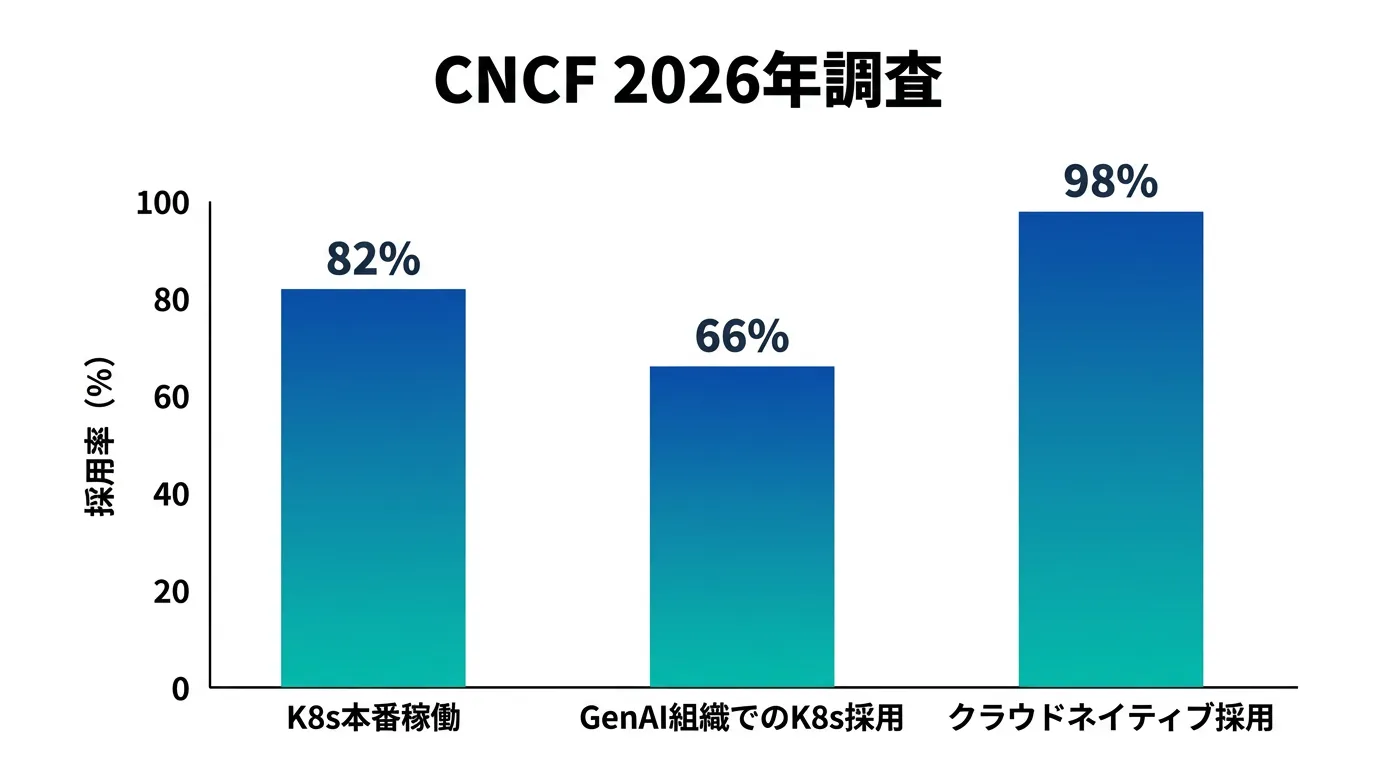
The numbers from CNCF's 2025 Annual Cloud Native Survey (published January 2026) are unambiguous:
- 82%: Organizations using containers run Kubernetes in production (up from 80% in 2024)
- 66%: Organizations with active GenAI usage run some or all AI inference workloads on Kubernetes
- 98%: Survey respondents have adopted cloud-native technologies
The CNCF Annual Survey Report paints a clear picture: Kubernetes is becoming the shared foundation for AI infrastructure — and it's no accident.
AI workloads have fundamentally different requirements from traditional web applications: dynamic GPU allocation, horizontal scaling for large-scale model inference, and workload isolation across multiple teams. Kubernetes has emerged as the only orchestration platform that addresses all of these simultaneously.
If you're looking to minimize the cost of building an AI platform, a managed K8s service like Kubo lets you spin up an equivalent Kubernetes environment at roughly 58% the cost of EKS — immediately. But first, it's worth understanding exactly why Kubernetes is necessary for AI.
3 Technical Reasons AI Workloads Require Kubernetes
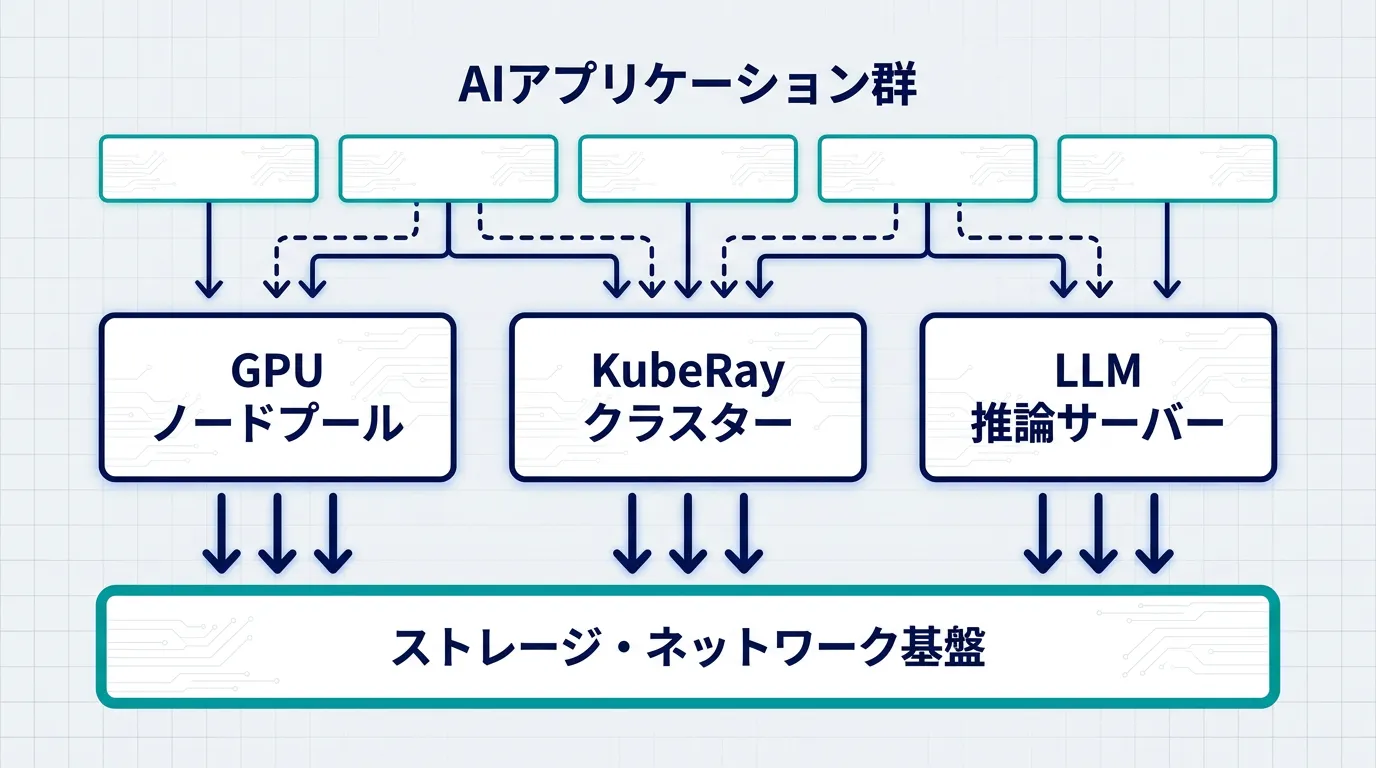
AI workloads have fundamentally different infrastructure requirements from standard web applications. CloudOptimo's 2026 analysis of Kubernetes and AI infrastructure summarizes these requirements clearly.
GPU Scheduling — How KubeRay and Kueue Changed Everything
GPUs are essential for AI training and inference, but they're expensive — efficient allocation is critical. The standard Kubernetes scheduler was designed around CPU and memory, and couldn't handle GPU-specific needs like multi-GPU bandwidth optimization and gang scheduling.
KubeRay and Kueue solve this problem.
- KubeRay: An operator that manages Ray distributed training and LLM inference on Kubernetes. Through RayCluster and RayJob CRDs, building multi-GPU inference endpoints becomes straightforward.
- Kueue: Job queue management for batch workloads. Priority control, fair resource sharing across teams, and automatic idle borrowing maximize GPU utilization. (Kueue GitHub for details.)
Microsoft's KubeCon 2026 GPU scheduling enhancements further signal ecosystem maturity. The integration of NVIDIA's KAI Scheduler with KubeRay now enables gang scheduling, automatic workload scaling, and prioritized inference job management.
LLM Inference Serving Scalability
Running LLM services like ChatGPT in-house requires the ability to handle sudden spikes in inference requests. By combining Kubernetes Horizontal Pod Autoscaler with KubeRay's RayServe, you can automatically add GPU nodes while keeping inference throughput in lockstep with demand.
According to Fairwinds' 2026 Kubernetes Playbook, organizations using K8s intelligent resource optimization have reported up to 70% reductions in cloud costs.
Multi-Tenancy for Safely Isolating AI Teams
In most organizations, data science teams, ML engineers, and production operations teams share the same infrastructure. Kubernetes namespace isolation, RBAC (role-based access control), and NetworkPolicies let you safely isolate each team's workloads while sharing resources efficiently.
Kueue's multi-tenancy features enable "fair-share scheduling" — per-team GPU quotas with automatic borrowing of idle resources — keeping GPU utilization high while distributing resources equitably across teams.
Platform Engineering Determines AI Adoption Velocity
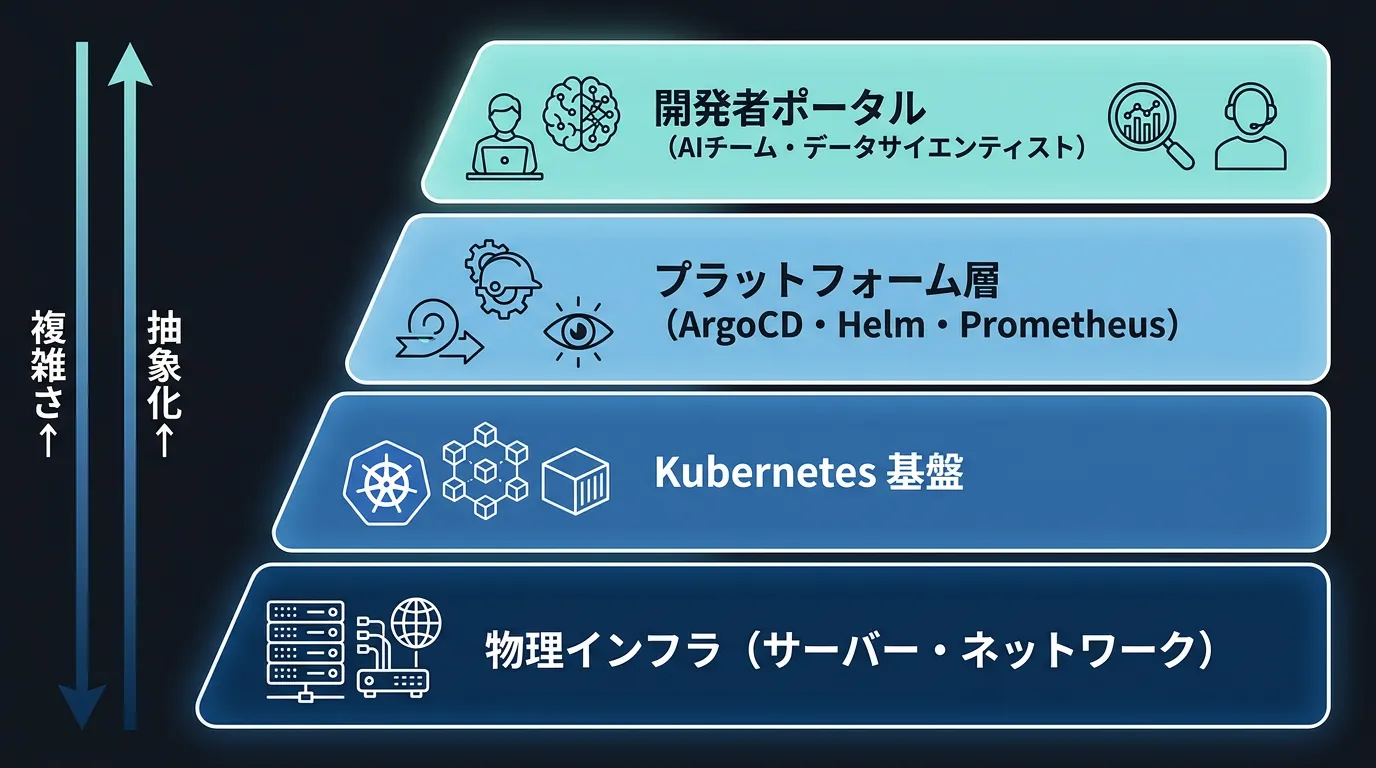
Another striking finding from the CNCF survey: by 2026, 80% of large software organizations are projected to have a dedicated platform engineering team.
A 2026 analysis of platform engineering trends describes the core purpose as "an abstraction layer that lets developers use AI without thinking about Kubernetes."
IDPs Are Transforming Access to AI Infrastructure
An Internal Developer Platform (IDP) encapsulates infrastructure complexity so developers can self-serve AI resources. They're built by combining portal tools like Backstage, Port, or Cortex with Kubernetes and Terraform.
The 2026 guide to building an internal Kubernetes platform with vCluster presents the ideal state of platform engineering: "Data scientists access a GPU-equipped K8s cluster via a single JupyterNotebook URL."
GitOps has become the standard deployment model for platforms, with ArgoCD and Flux keeping Kubernetes cluster state continuously synchronized with Git repositories. Kubo ships with built-in ArgoCD/Flux integration — you can start building this kind of IDP immediately.
Cultural Resistance Is Now the Biggest Kubernetes Adoption Barrier
The CNCF survey revealed a notable shift: in 2026, the biggest obstacle to Kubernetes adoption is no longer technical complexity — it's organizational culture (47%). The technology has matured. The challenge now sits on the human and organizational side.
Platform engineering is also a mechanism for lowering that cultural barrier. By creating environments where teams can "use AI without learning K8s," data scientists and ML engineers can leverage AI infrastructure autonomously.
If you want to systematically build your organization's AI infrastructure skills, the AI-Driven Development Seminar offers hands-on Kubernetes × AI infrastructure design training — led by engineers with real-world production experience in K8s and MLOps design.
The Hidden Cost Reality of Building K8s AI Infrastructure
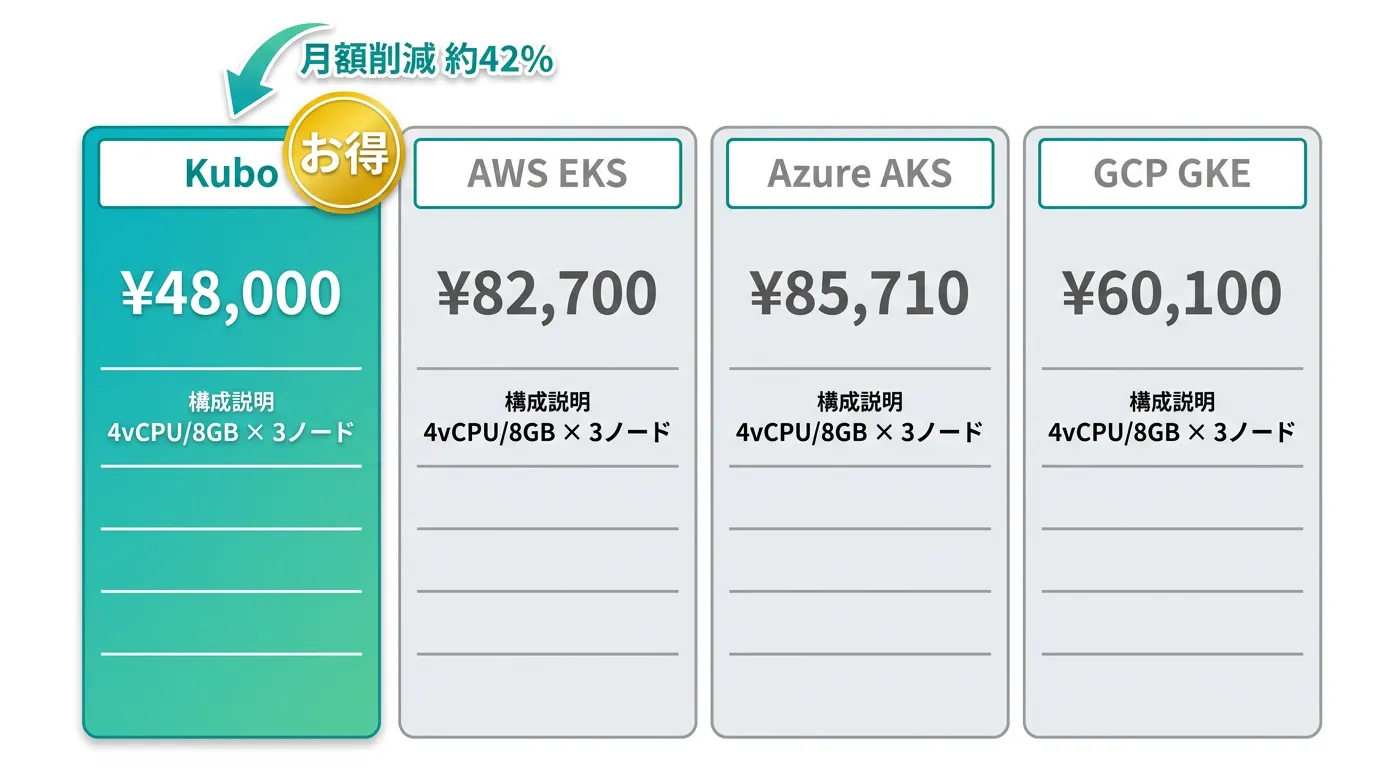
"We know Kubernetes is the right choice — but the economics don't work." This is the dilemma many CTOs and infrastructure leads face. According to Sedai's 2026 detailed cost analysis of managed Kubernetes providers, compute costs account for 70–85% of total K8s running costs, making provider selection a direct TCO driver.
Here's a monthly cost comparison for a 3-node cluster (4vCPU / 8GB RAM / 40GB storage × 3):
| Provider | Monthly Total |
|---|---|
| Kubo | ¥48,000 |
| AWS EKS | ¥82,700 |
| Azure AKS | ¥85,710 |
| GCP GKE | ¥60,100 |
Equivalent Kubernetes functionality at roughly 58% the cost of EKS. But cost is only part of the picture.
3 hidden cost factors often overlooked with EKS/AKS/GKE:
- Vendor lock-in risk: The deeper you integrate with AWS- or Azure-specific services, the higher your migration cost grows
- Specialized talent costs: Cloud-provider-specific K8s operational knowledge creates recruiting and training overhead
- Operational management costs: Even with managed services, node upgrades, security patch application, and monitoring configuration remain your responsibility
Sum these up and you exceed the sticker price of instance costs alone. With AI workloads, GPU node costs compound on top — making TCO comparison essential.
Launch Your AI Infrastructure Today at Half the Cost with Managed K3s
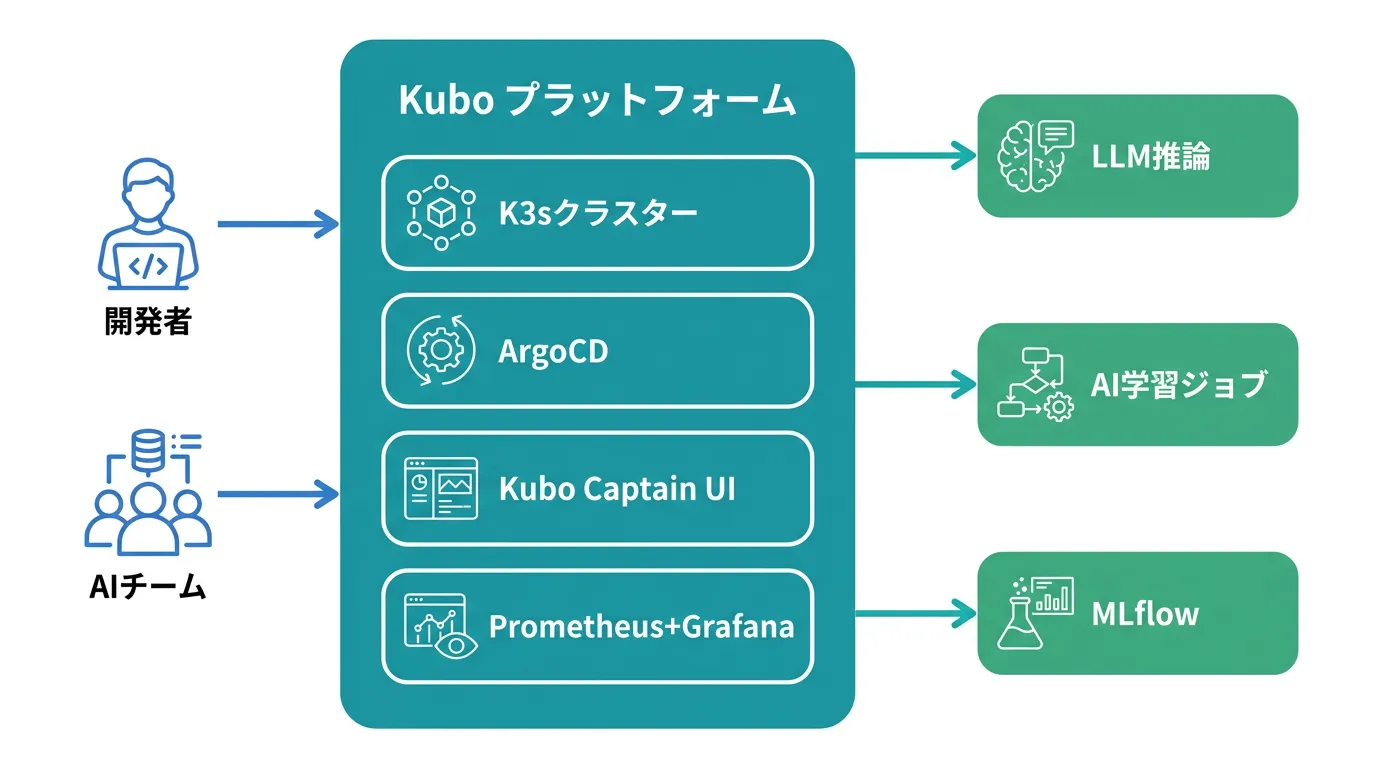
Kubo is a managed Kubernetes service built on K3s. K3s is a CNCF-certified lightweight Kubernetes distribution that maintains full compatibility with standard K8s while dramatically reducing resource consumption.
Why Build Your AI Platform on Kubo
1. AI-Driven Deployment (NoOps) Just say "deploy this model" in plain language. No YAML authoring, no kubectl commands. Data scientists can ship AI services to production without needing an infrastructure engineer.
2. Kubo Captain UI (Visible Management) A browser-based management UI gives you real-time visibility into GPU node utilization, pod status, and cost trends. Full transparency — no black boxes.
3. Pure Kubernetes (No Vendor Lock-In) Standard K8s APIs and toolchain (Helm, ArgoCD, Prometheus, etc.) work as-is. Migrate without discarding any of your AWS/Azure K8s knowledge or tooling.
4. GitOps Built In ArgoCD and Flux integration is built-in from day one. Automate AI model deployments via GitOps — a git push is all it takes.
5. Monitoring Built In Prometheus + Grafana ship standard, with dashboards for GPU utilization, inference latency, and cost optimization available with zero additional configuration.
A Real Migration Scenario
"We moved our K8s environment from EKS at ¥82,700/month to Kubo at ¥48,000/month — and had ArgoCD integration up and running the same day." This is the scenario Kubo makes real.
If you'd like to discuss your AI infrastructure architecture specifically, use Contact Us for a free consultation. We handle concrete questions on AI infrastructure cost estimation, K3s production design, and GPU node configuration.
Summary
The convergence of AI platforms on Kubernetes is a structural shift, not a passing trend.
- As the CNCF 2026 survey clearly demonstrates, 66% of GenAI organizations have chosen K8s
- GPU scheduling (KubeRay, Kueue), LLM inference scaling, and multi-tenant management all align directly with Kubernetes' core capabilities
- Platform engineering is advancing the abstraction that lets developers use AI without thinking about K8s
- But EKS/AKS/GKE present a dilemma of high costs and vendor lock-in
Kubo's answer to this dilemma is clear: K3s-based infrastructure at roughly 58% the cost of EKS, full standard K8s compatibility, and day-one availability of key tools — ArgoCD, Helm, Prometheus, and more.
Running AI workloads in production requires a robust K8s foundation. With Kubo, you can build that AI-era infrastructure foundation right now. Review detailed cost comparisons on the Pricing page, or contact us to discuss your AI infrastructure design.